
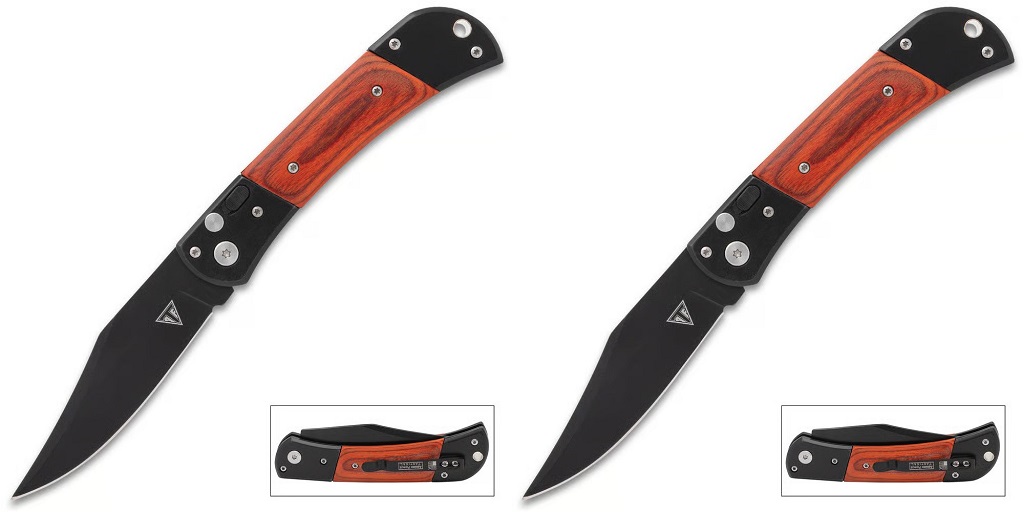
Whether your collection has a push button automatic knife or you carry one on the daily for its convenience (and the fact that you can easily deploy it with one hand) one thing is sure: you need to know how to take care of it.
Folding knives are more complex than fixed blades and require a little more care and attention. Keeping the knife clean will ensure it continues to open and close smoothly, that the lock works, and that corrosion is forestalled.
This short post will break down some of those details.
Keeping the Blade Clean
After every use of the knife, make sure you thoroughly clean the blade. Wipe down the blade with a clean, dry cloth. You can use a damp cloth if anything sticky or oily has left a residue on the blade.
That being said, it’s best not to run the knife under water, even if there is a lot left on the blade. Completely submerging the knife will allow water into the inner mechanism, which can result in corrosion because once the knife gets wet it’s hard to thoroughly dry out the interior of the knife without taking it apart.
Protecting Against Corrosion
Keeping the blade of the knife clean and dry is your first and most effective defense against corrosion, but it’s not the only step for you to take.
First, after you’ve cleaned the knife, make sure the blade is completely dry before you store the knife. A good practice is to apply a thin coat of oil to the blade to help seal out oxygen and moisture to prevent rust.
Second, the other hardware on the knife should be insulated with a drop or two of oil.. This likewise will seal out moisture and oxygen which will help to prevent corrosion.
The Inner Works
Lastly, it’s important to recognize that a push button automatic knife is fairly complex and has a more involved set of inner mechanisms, even among folding knives. There is the lock to care for as well as the spring mechanism that deploys the blade.
Now, keep in mind that all push button automatic knives are a little different. They all have different locks and some may utilize different opening mechanisms – for instance, OTF and OTS knives can be very different.
What is important, however, is that you periodically disassemble the knife to clean the interior. You don’t need to do this too frequently – probably about once per year – but it is important that you do so nonetheless.
Take the knife apart carefully, paying close attention to each step so that you can reverse the process when you need to reassemble the knife.
Once you’ve removed all the hardware and the spring(s), clean each individually, remove any lint or other deposits from the interior of the knife, then make sure all parts are dry before reassembling according to the reverse process that you followed to take the knife apart in the first place.
Safe Storage
Where you keep your knife is also going to impact its condition and longevity. Never store it anywhere that it will experience chronic humid conditions. That’s a ticket to quick rust, even for a stainless blade.
Ideally, keep it somewhere cool and dry, at least anytime it’s not in your pocket.
Here for a New Push Button Automatic Knife?
In the market for a new push button automatic knife but don’t have one yet? Get it online at BudK. They carry plenty, and at least now that you have read this post you will know how to take care of the knife.