
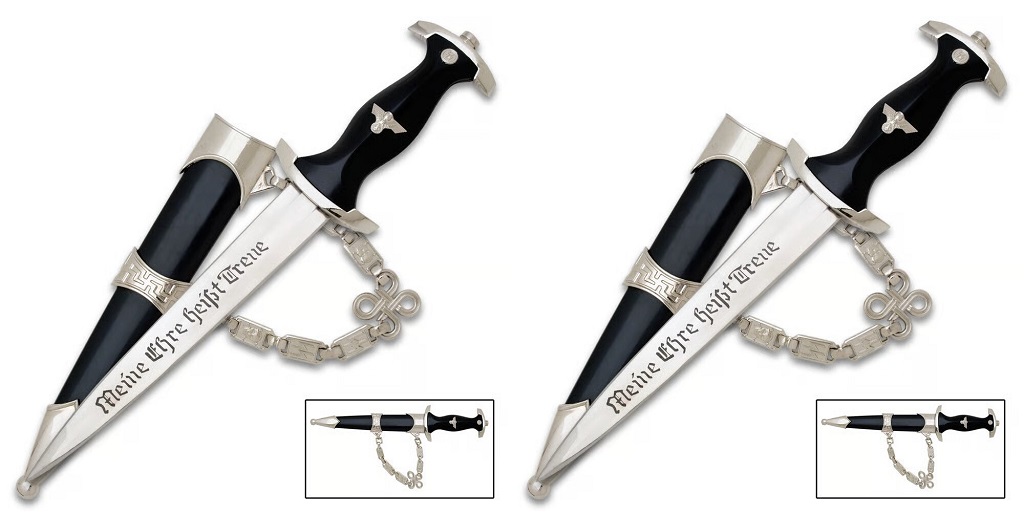
While all daggers are in practice weapons, there is a lot of variation in their designs, and it’s the blade profile (predominantly) that determines how a given pattern was intended to be used, as well as what its relative advantages were.
For instance, some patterns were designed to be thrust, whereas others were more effective at cutting or slashing or turning an enemy’s blade. This short post will tell you how to identify the main advantages of a dagger profile by feature.
Thrusting Daggers
Daggers that were specialized for thrusting generally had long, thin blades. Length aside, the thinner the blade and the point, the better the blade profile would be for thrusting attacks.
This can be seen in both stiletto profiles as well as in rondel patterns. Both of these had long, thin blades with a needle point that were intended to be thrust into an opponent. The thin blade of the rondel, for instance, even passed up the edge – many rondels cannot be used for cutting, only thrusting.
The concentrated pressure on the point meant that these profiles could be used more effectively for stabbing attacks, even when an opponent was wearing protecting armor like mail, as the finer, thinner point could slip through, and potentially split, mail rings or even other armor.
Slashing Daggers
Daggers with longer, heavier blades and edges were more effective than stiletto and rondel profiles for slashing than they were for stabbing. Some patterns that fit this description include the baselard, seax or sax, and cinquedea profiles.
Not to suggest that these weapons were ineffective for thrusting attacks, but their wider, heavier, longer blades would also have been effective for slashing, particularly in the case of the cinquedea.
These daggers had large, heavy blades that would have been more effective to swing with a heavy hand, to inflict deep slash wounds, or even to split leather armor or cause percussive damage.
Parrying Daggers
Some patterns, such as the knightly dagger or the main gauche, with their protective crossguards, would have been extremely effective as sidearms for parrying an enemy’s blade.
These short daggers were not designed so much as offensive weapons (though they could certainly have been used in that capacity) but for defensive purposes. With their wide, flat blades and protective crossguards, they were used to turn and even trap and redirect an opponent’s strikes.
For General Utility
Lastly, many profiles, such as hunting daggers, dirks, sax knives, and others, were intended first for camp chores or general utility than they were for use as weapons. This however is a catch-all bin; there are no specific attributes to look for that would give this information away.
Where to Learn More About Dagger Profiles
Interested in learning more about different dagger patterns or seeing what some of the types mentioned actually look like? Check out BudK. They carry a wide range of different daggers, knives, and other personal defense gear, along with swords and other prepper supplies.